
In this article
Patio Materials Guide Perth: Why Our Climate Is a Different TestRoofing Materials: What Actually Happens Over 10–20 YearsColorbond SteelInsulated Roof PanelsPolycarbonateTimber Roofing and Exposed BattensFraming and Posts: Steel vs Timber vs AluminiumSteel FramingTimber FramingAluminium FramingFlooring and Decking: A Quick NoteMaintenance Is Part of the Material ChoiceWhich Material Suits Your SituationConclusion
This patio materials guide Perth homeowners can rely on breaks down exactly how each option performs after ten or twenty years in WA’s climate. Perth’s climate is brutal on the wrong materials and barely notices the right ones. Before you pick a roof sheet, a post, or a decking board for your patio, it helps to know exactly how each option behaves after ten or twenty years of WA sun, heat, dry air and — if you’re in the western suburbs — salt.
Patio Materials Guide Perth: Why Our Climate Is a Different Test
Perth gets more sunshine hours than almost any other Australian capital (see the Bureau of Meteorology’s climate averages for the numbers), and that’s the first thing that separates a patio built here from one built in Melbourne or Hobart. UV degrades sealants, coatings and raw timber faster than heat alone does, and Perth roofs cop it nearly year-round. Summer takes it further — extended runs of high-30s and 40-degree days push polymers, adhesives and paint systems to their limits, and dark-coloured Colorbond roofing can sit well above ambient temperature on a still February afternoon.
Then there’s the dry side of the equation. Perth’s low humidity is genuinely good news for steel — rust needs moisture to progress, and a lot of our air simply doesn’t carry enough of it for long. But that same dryness is hard on timber, which shrinks, cups and cracks as it loses moisture unevenly across a board.
And if your block is within a few kilometres of the coast — Scarborough, Fremantle, Rockingham, Mandurah, City Beach and anywhere the sea breeze rolls through unfiltered — airborne salt changes the rust equation again, attacking exposed steel edges and fixings far faster than the same product would corrode inland.
Termites are the other local wildcard. WA’s sandy soils and dry heat suit several destructive species just fine, and an untreated or poorly protected timber frame near the ground is genuinely at risk here, not just in theory. None of this means one material wins outright — it means each one has a specific job it’s suited to and a specific way it fails when it’s used outside that job.
-
Intense, near-constant UV — degrades sealants, coatings and raw timber faster than any other Australian capital, even outside summer.
-
Extended high-30s and 40-degree heat — pushes dark roof colours, adhesives and polycarbonate well past comfortable operating temperatures.
-
Low humidity — great news for steel’s rust resistance, but the main cause of timber shrinkage, cupping and cracking.
-
Coastal salt air — accelerates corrosion at cut edges and fasteners in western-suburb properties, even where the frame is otherwise well protected.
-
Sandy soils and termite pressure — a genuine structural risk for untreated timber posts and framing, not a rare edge case.
Roofing Materials: What Actually Happens Over 10–20 Years
Roofing takes the most UV and heat load of any part of a patio, so it’s where climate performance matters most. This section covers how each option ages in Perth specifically — for a full side-by-side comparison of roofing profiles and insulation performance, see our guide to choosing the perfect patio roof.
Colorbond Steel
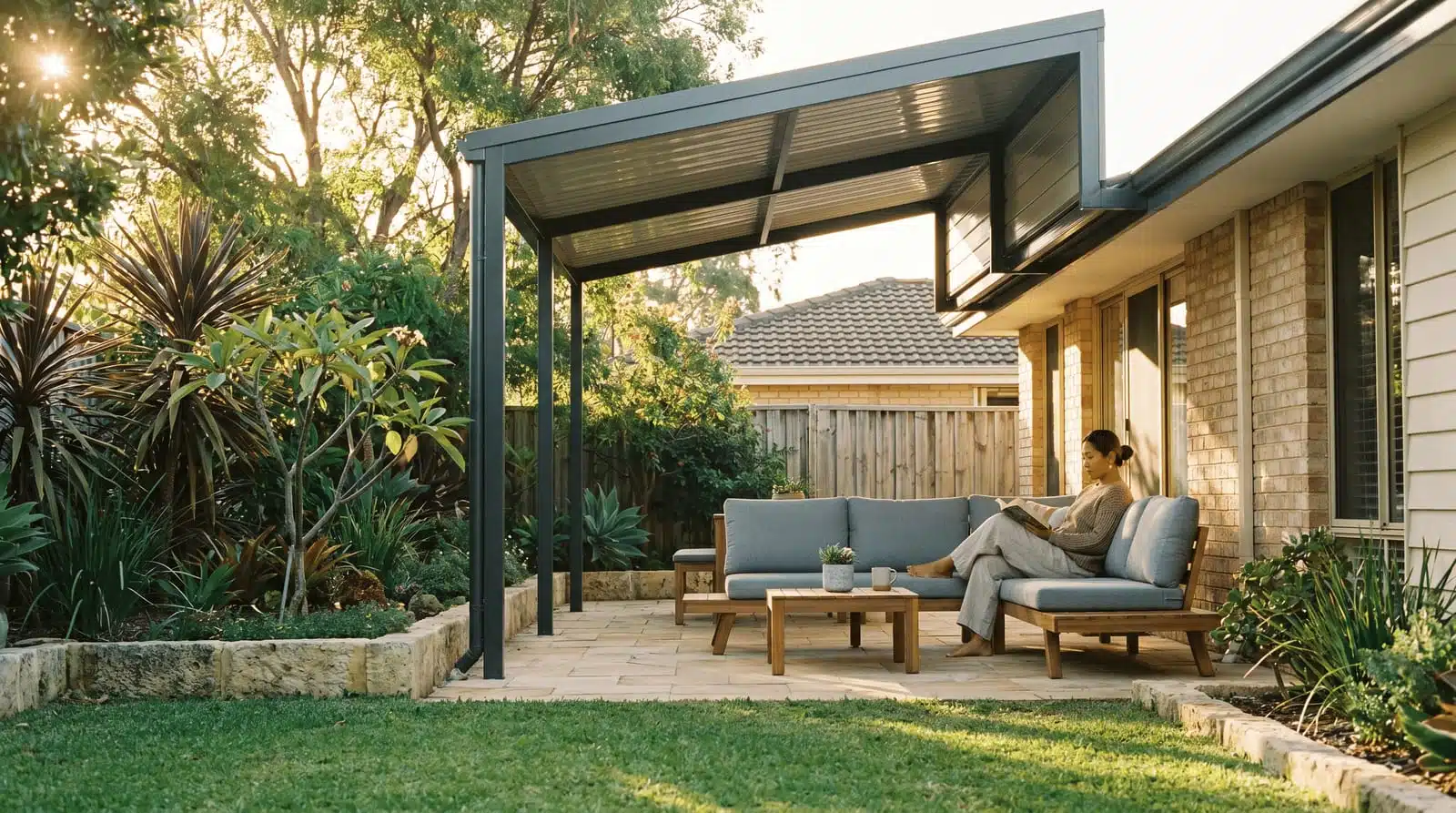
Colorbond is the default for a reason. The steel core doesn’t care about UV at all, and Perth’s dry climate is genuinely kind to it — most inland and middle-suburb installs will run 20-plus years without a rust issue if the sheeting was cut, drilled and installed correctly. The part that does age is the paint finish: colour fade and a slight chalky feel are normal after 15–20 years of Perth sun, especially on darker colours like Monument or Ironstone, which absorb more heat and UV energy than lighter tones such as Surfmist or Shale Grey.
The one place Colorbond needs real attention is the coast. Cut edges, screw heads and any point where the protective coating has been breached are the vulnerable spots, and salt-laden air accelerates corrosion at exactly those points. Within a couple of kilometres of the ocean, insist on stainless fasteners and proper edge treatment, and expect to hose salt residue off the roof every few months rather than leaving it to rain (which, in a low-rainfall climate, doesn’t come often enough to do the job for you).
Insulated Roof Panels
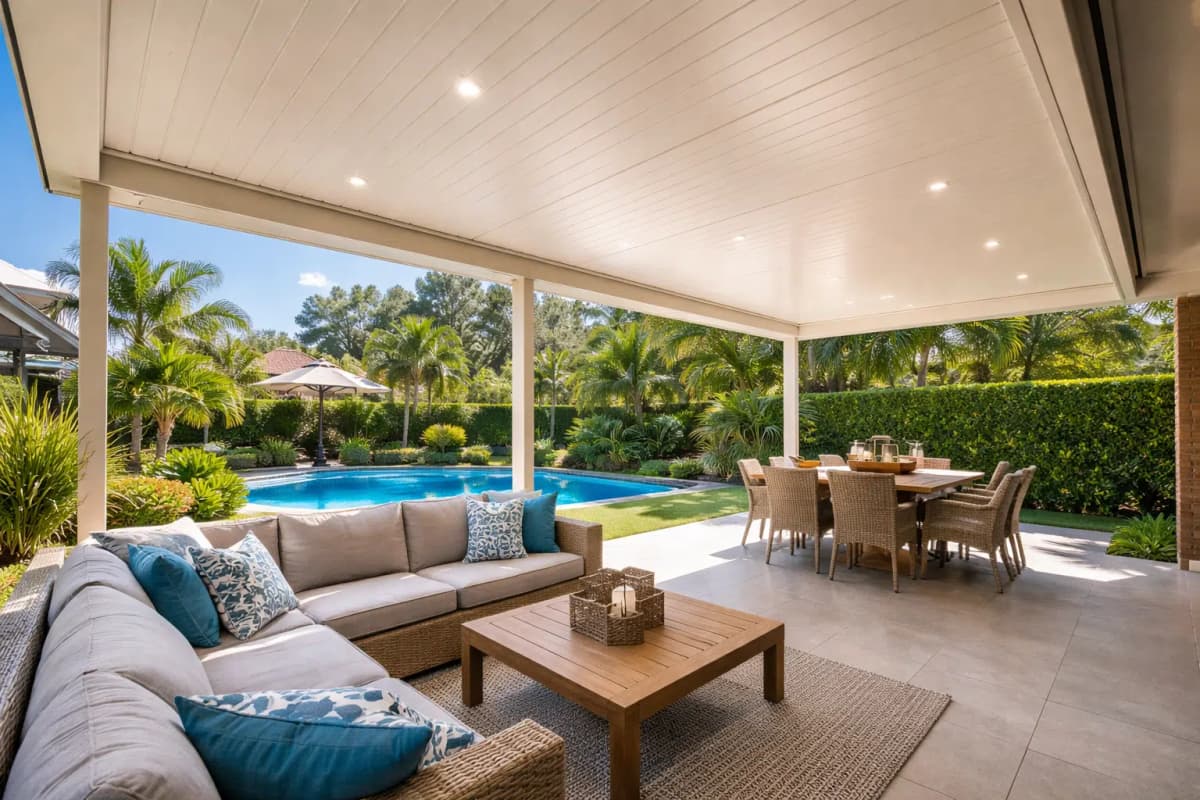
Insulated sandwich panels perform like Colorbond on the outer skin — same steel, same UV and rust behaviour — with the added benefit of a foam core that meaningfully cuts down the “furnace” effect on high-40s days. The tradeoff over a long timeframe is the join system: panel-to-panel seals and end flashings need to stay watertight, and in a climate with intense UV and big daily temperature swings, sealants at those joins are the first thing to fail if they weren’t installed to spec. Expect to have joints checked every few years rather than assuming a “set and forget” roof.
Polycarbonate
Polycarbonate lets light through, which is exactly why Perth’s UV intensity is its biggest enemy. Even UV-stabilised sheet will yellow and lose some clarity over 10–15 years under our sun load, and cheaper or non-stabilised sheet can go brittle and crack well before that. It’s a legitimate choice for a louvre roof, skylight strip, or a spot where you specifically want light rather than shade — just don’t expect the 20-year lifespan you’d get from steel, and budget for a sheet replacement at some point if you go this route.
Timber Roofing and Exposed Battens
Exposed timber roofing or feature battens look great on day one and are the highest-maintenance roofing option in this climate, full stop. Perth’s UV strips the natural oils out of timber quickly, and the low humidity means boards dry out and move — cupping, splitting and fastener pull-through are common once a board has been through a few Perth summers without recoating. If you want the timber look, a timber-look Colorbond profile or timber battens under a separate weatherproof roof (rather than as the weatherproofing layer itself) will get you the aesthetic without the annual sanding-and-oiling cycle.
Framing and Posts: Steel vs Timber vs Aluminium
The frame carries the structural load for decades, so its climate performance matters even more than the roof sheet sitting on top of it.
Steel Framing
Steel — whether it’s Colorbond-finished or a heavier structural section — is the standard for a reason that’s specific to Perth: dry air plus a factory-applied coating equals a very slow corrosion clock. Inland and middle-suburb frames routinely go 20+ years with nothing more than an occasional wipe-down. Coastal frames need the same caution as coastal roofing — quality coatings, sealed cut ends, and stainless or coated fixings at every join. Steel also doesn’t move with humidity swings the way timber does, so joints stay tight and doors and screens stay square year after year.
Timber Framing
Timber framing has a genuine termite exposure problem in Perth that steel and aluminium simply don’t have. Sandy soils across the metro area suit subterranean termites, and any timber post making contact with or sitting close to the ground is a target unless it’s been properly treated and detailed.
On top of that, Perth’s low humidity causes seasonal movement — shrinkage, cracking and joint loosening — that a steel frame never experiences. Hardwood posts on isolated concrete footings with proper termite barriers can work and can look fantastic, but it’s a higher-maintenance, higher-risk choice here than in wetter, termite-lighter climates, and it needs a builder who details it properly rather than treating it like a like-for-like swap for steel.
Aluminium Framing
Aluminium sits in an interesting spot: it doesn’t rust the way steel can and it’s naturally more salt-tolerant, which makes it a genuinely strong option for exposed coastal sites where corrosion is the main worry. It’s lighter than steel too, which suits louvre roof systems and larger clear-span openings. The tradeoff is cost and, for very large spans, stiffness — aluminium sections generally need to be beefier than an equivalent steel section to avoid flex, which is why most standard Colorbond patios in Perth are still steel-framed, with aluminium reserved for louvres, screens and coastal-specific builds.
Flooring and Decking: A Quick Note
Most Perth patios sit over an existing concrete slab or new paving, and both handle the climate here without drama — concrete doesn’t care about UV, and a quality paver holds its colour for many years, though very dark pavers do get uncomfortably hot underfoot on a 40-degree day.
If you’re considering timber decking as part of the patio, the same rules from the framing section apply: it’s UV-sensitive, movement-prone in our dry air, and needs ground clearance and treatment to manage termite risk. Composite decking sidesteps the termite and cracking issues but still needs a UV-stable, Perth-appropriate product — cheaper composites can fade or warp under sustained heat just like poor-quality polycarbonate does.
Maintenance Is Part of the Material Choice
Every material above has a maintenance schedule attached to its climate performance, and the honest version of “low maintenance” depends entirely on which material you started with. We’ve covered the specific upkeep tasks — what to check, how often, and what a coastal property needs beyond a standard inland maintenance routine — in our low-maintenance patio guide. The short version: steel and aluminium ask the least of you over 20 years, and timber and polycarbonate ask the most.
Which Material Suits Your Situation
If you just want the short answer before you talk to a builder, here’s how it breaks down by scenario:
-
Standard inland or middle-suburb block — Colorbond steel roofing on a steel frame, no real climate compromises, 20+ year lifespan with minimal upkeep.
-
Within a couple of kilometres of the coast — Colorbond with stainless fasteners and sealed cut edges, or aluminium framing where corrosion resistance matters more than raw stiffness.
-
You want light rather than full shade — polycarbonate, accepting a shorter lifespan and eventual yellowing under Perth’s UV load.
-
You want a timber look — a timber-look Colorbond profile or timber battens over a separate weatherproof roof, not timber as the structural or weatherproofing layer itself.
-
You’re set on real timber posts or framing — hardwood on isolated footings with proper termite barriers and detailing, and a builder who won’t treat it as a drop-in swap for steel.
Conclusion
There’s no universally “best” patio material — there’s a best material for your specific block, your distance from the coast, and how much upkeep you’re willing to do over the next two decades.
In Perth, that generally means Colorbond steel roofing on a steel frame for most builds, aluminium where coastal corrosion or louvre design calls for it, and timber used carefully — if at all — given the termite and movement issues our climate creates for it. Get the material choice right at the start and you’re building something that still looks and performs like new in 2046, not something you’re patching up by 2030.
If you want a straight answer on what will actually last on your specific property, talk to us. Get in touch with The Patio Factory for a free measure and quote, and we’ll tell you honestly which materials suit your site.
Check out our social media
In this article
Patio Materials Guide Perth: Why Our Climate Is a Different TestRoofing Materials: What Actually Happens Over 10–20 YearsColorbond SteelInsulated Roof PanelsPolycarbonateTimber Roofing and Exposed BattensFraming and Posts: Steel vs Timber vs AluminiumSteel FramingTimber FramingAluminium FramingFlooring and Decking: A Quick NoteMaintenance Is Part of the Material ChoiceWhich Material Suits Your SituationConclusion
Ready for your dream patio?
Get a free design consultation and quote from Perth's most trusted patio builders.
Book a free onsite consultationCall 08 9451 5777Related articles
Ready to picture it in your own backyard?
Read all you like. When you want real answers for your block, we'll come to you.
Book a free onsite consultation