

In this article
What “insulated” actually means on a patio roofHow much cooler — and quieter — does it actually get?The cost-benefit question: what you pay extra, and what you get backWhen it’s worth the extra spend — and when it isn’tWhich roof styles it suitsGable roofsSkillion and flat roofsDome roofsLiving with an insulated roof day to dayGetting council approval sortedConclusion
For most Perth homes, yes — an insulated patio roof earns its higher price tag through a genuinely cooler, quieter, more usable outdoor space almost every month of the year. It costs more upfront than a standard single-skin roof, and if your patio only ever gets used for the odd Sunday barbecue, that extra spend might not stack up. But if you want a space you’ll actually sit in through a 40°C February afternoon, it’s one of the few outdoor upgrades that pays you back every day you use it.
What “insulated” actually means on a patio roof
An insulated patio roof isn’t just a thicker sheet of Colorbond® — it’s a sandwich panel built from three bonded layers: a steel top skin that takes the weather, a rigid foam core that does the actual insulating, and a smooth steel or aluminium underside that doubles as your new ceiling. Compare that to a standard single-skin roof, which is a single sheet of corrugated steel over battens with nothing but a few millimetres of metal between your patio and the sky, and it’s easy to see why the two feel so different to stand under.
In Australia, the two systems you’ll come across most are SolarSpan® (made by Bondor) and Cooldek® (made by Stratco/Lysaght). Both use Colorbond® steel outer skins, come in the full Colorbond® colour range and a few core thicknesses, and both are structural — meaning they can span further between beams than single-skin sheeting. That’s not just a comfort feature; it also means fewer support posts breaking up your view.
How much cooler — and quieter — does it actually get?
The panels won’t turn your patio into an air-conditioned room, but they do stop the “hot tin roof” effect that makes uninsulated patios unbearable by mid-afternoon. Installers commonly report a difference in the order of 8–10°C on a hot roof compared to bare single-skin steel, and the difference is most noticeable on north- and west-facing patios that cop the full brunt of Perth’s afternoon sun. If your outdoor area faces west, this is often where insulation makes the single biggest difference to whether the space gets used or sits empty all summer.
It works the other way in winter too — the foam core slows heat loss, so the space holds warmth longer into a cool Perth evening and stretches how many months a year you’ll actually use it. The same core also stops the underside “sweating” with condensation on cold mornings the way bare steel can, and it dampens sound significantly, so a downpour or hailstorm on the roof is a dull patter rather than a drum solo.
The cost-benefit question: what you pay extra, and what you get back
Insulated panels cost more per square metre than a basic single-skin roof — you’re paying for the extra core material and the lamination process that bonds the three layers together. Exactly how much more depends on your span, the panel thickness, and the finish you choose, so it’s worth getting a proper on-site quote rather than going off a number you saw online.
-
Fewer support posts — because the panels span further than single-skin sheeting, some of that cost gets clawed back in reduced structural steel and a cleaner-looking patio.
-
Lower cooling load on the house — an insulated patio attached to your home blocks radiant heat from working its way in through open doors and windows, which takes some pressure off your air conditioning in summer.
-
Next to no ongoing maintenance — there’s no painting, sealing, or re-coating required; an occasional hose-down is about it.
-
Durability that holds its value — BlueScope® steel and Colorbond® coatings resist rust, UV fading, warping, and termites, which matters given Perth’s sun exposure and the salt air in coastal suburbs.
-
Stronger resale appeal — buyers tend to see a genuine all-weather outdoor room as a premium feature, more so than a roof that’s essentially a shade cover with a steel top.
If budget is the sticking point rather than the concept, ask about supply-only or DIY-friendly kit options — you can manage part of the labour cost yourself, though council approval and correct installation still apply either way.
When it’s worth the extra spend — and when it isn’t
-
You use the patio most days, not just on special occasions — the more you use the space, the faster the extra cost pays for itself in comfort.
-
Your patio faces north or west — these get hit hardest by Perth’s sun, and insulation makes the biggest practical difference here.
-
You want a genuine extra room, not just shade — if you’re after downlights, a ceiling fan, maybe an outdoor heater, and a finished look, insulated panels are built for that.
-
You’re on a tight budget and only need basic shelter — if the patio is mainly for parking the trailer or keeping the washing dry, a standard single-skin roof will do the job for less money.
-
You rarely use the space in peak heat — if your patio sits in shade for most of the day already, or you use it mostly at night, the thermal benefit matters less and the cost-benefit case is weaker.
Which roof styles it suits
Gable roofs
The classic pitched, triangular profile already helps hot air rise and move out through the peak. Insulated panels stop that heat radiating straight back down into the space, so you get the openness of a gable design without the trade-off.
Skillion and flat roofs
These lower-pitched, single-direction designs have less airspace between the roof and the people underneath, so insulation is doing more of the work here. It’s especially worth considering on skillion patios with tight clearance, where you can’t rely on height alone to keep things cool.
Dome roofs
Less common paired with insulated panels, but it can be done where the curved profile is more about the architectural statement. You still get the thermal benefit underneath, just in a less typical shape.
Living with an insulated roof day to day
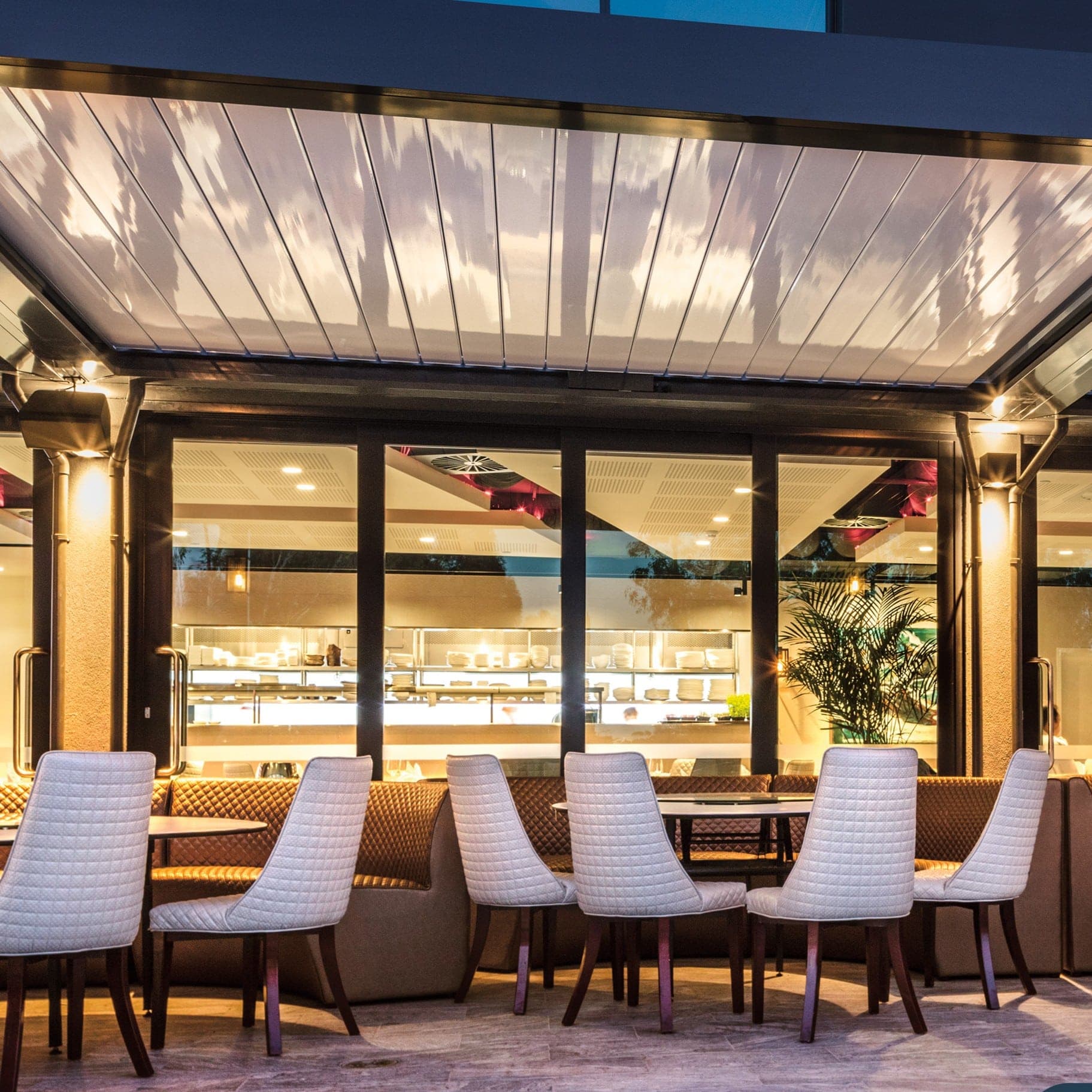
The flat, finished underside is the other half of the appeal — it looks like an indoor ceiling rather than exposed roofing, which makes it straightforward to add recessed downlights, a ceiling fan, or an outdoor heater without the space feeling like an afterthought.
-
Hose it down periodically — clears dust and, in coastal suburbs, salt residue that can dull the finish over time.
-
Clear the gutters each autumn — before Perth’s winter rain arrives, so water isn’t pooling against the roofline.
-
Check joints, flashing, and seals — a cracked bead of silicone is an easy fix now and a leak later.
-
Wipe the ceiling finish with mild detergent — avoid harsh chemicals, which can dull or damage the coating.
-
Get a professional look-over every few years — worth doing on any patio roof, but especially one you’re relying on for year-round use.
Getting council approval sorted
Most patio roofs attached to a house in WA need council or building approval regardless of which roofing system you choose — insulated panels aren’t an exception, and they’re not extra red tape either, since the approval process is much the same either way. Patio Factory handles the engineered drawings, permit lodgement with your local council, and Building Code of Australia compliance as part of the build, so it’s one less thing on your plate.
Conclusion
An insulated patio roof costs more than a basic single-skin one, and it should — you’re getting a materially cooler, quieter, more durable structure that behaves more like an extra room than a roof over a slab. For a Perth home where the patio actually gets used through summer, that trade-off is usually a straightforward yes. If your needs are simpler, a standard roof isn’t a wrong choice, just a different one.
The best way to know what it’ll cost for your specific patio is to get in touch with Patio Factory for a free, no-obligation quote based on your home’s size, orientation, and the look you’re after.
Check out our social media
In this article
What “insulated” actually means on a patio roofHow much cooler — and quieter — does it actually get?The cost-benefit question: what you pay extra, and what you get backWhen it’s worth the extra spend — and when it isn’tWhich roof styles it suitsGable roofsSkillion and flat roofsDome roofsLiving with an insulated roof day to dayGetting council approval sortedConclusion
Ready for your dream patio?
Get a free design consultation and quote from Perth's most trusted patio builders.
Book a free onsite consultationCall 08 9451 5777Related articles

Ready to picture it in your own backyard?
Read all you like. When you want real answers for your block, we'll come to you.
Book a free onsite consultation