
In this article
The Front Setback Rule That Disqualifies Half the JobsSetbacks Are Set by the R-Codes, Not by Whether You Use an EngineerHow We Check Before You CommitSide and Secondary Street SetbacksHow Much of Your Block Can Actually Be CoveredThe Tree-Planting Rule on Smaller BlocksA Real Example: The Cottage-Block InfillStreet and Verge Bond PermitsWhat to Expect on a Smaller or Modern BlockGetting It Right the First Time
Getting shire approval for a carport in Perth comes down to a handful of rules that catch most homeowners off guard — the front setback above all else, but also block coverage limits, side setbacks, and a tree-planting requirement that’s new to a lot of blocks. Here’s what actually determines whether your carport gets approved.
The Front Setback Rule That Disqualifies Half the Jobs
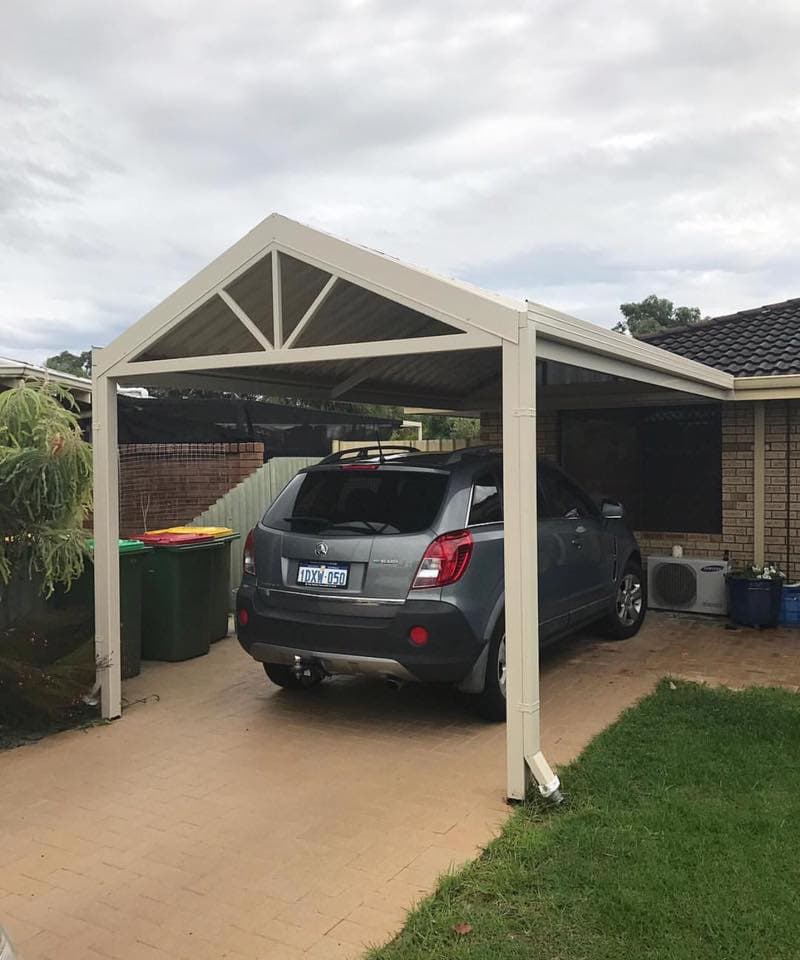
A carport must sit at least 6 metres back from the front boundary on an R20 zoned lot — roughly where your letterbox sits. On R30 and R40 lots, that drops to 4 metres.
If your home sits 9 metres back from the front boundary, a 6 metre carport still leaves 3 metres of clearance, and approval is very achievable. But on many newer, smaller blocks, the house itself is only 6 metres from the boundary — leaving no room to build a compliant carport in front of the home at all.
Setbacks Are Set by the R-Codes, Not by Whether You Use an Engineer
All carport setbacks — front, side, and rear — are governed by the Residential Design Codes (R-Codes) and the zoning of the individual property. Bringing in a certified engineer doesn’t change what the setback rules allow — the setback itself is a planning control, not an engineering one, so it applies the same regardless of who’s involved in the application.
How We Check Before You Commit
Before anything else, we pull up Google Maps and measure the approximate distance from the front of the house to the boundary — it takes about two minutes and tells us a great deal about whether approval is realistic. If there are existing carports on nearby properties, that’s a strong signal the shire has approved them before and is likely to again. If there are none on the street at all, that’s usually not a coincidence — it typically means the shire has been consistently rejecting them in that area.
Side and Secondary Street Setbacks
For carports up to 14 metres in length, a 1 metre side setback to the post is required. For anything longer than 14 metres, that increases to 1.5 metres.
There’s some flexibility here: a carport can have its posts sitting directly on the boundary, as long as the eaves, gutters, and roof overhang are set back at least 500mm — but only if the carport is no longer than 10 metres, no taller than 2.7 metres, and positioned behind the primary street setback.
Carports also need to sit back 1.5 metres from any secondary street frontage, and eaves or minor projections can’t encroach more than 0.75 metres into a setback zone.
How Much of Your Block Can Actually Be Covered
Shires cap the percentage of a block that can be covered by permanent roof structures, and that cap is set by the property’s zoning. Enforcement varies noticeably by shire — some will tolerate going slightly over; others reject at the decimal point. As a rule of thumb: if your allowance is 60% and your design comes in at 60.001%, some shires will knock it back outright, no matter how marginal the overage looks on paper.
The Tree-Planting Rule on Smaller Blocks
Under the current R-Codes, smaller blocks must reserve a minimum 2m × 2m area for tree planting somewhere on the property. The less space a block has to begin with, the harder this makes fitting a compliant carport — it’s a genuine constraint worth knowing about before you fall in love with a full-coverage design.
A Real Example: The Cottage-Block Infill
A common Perth layout: a main house built boundary-to-boundary along the block, a gap, then a freestanding garage at the rear. Shires will often allow that gap to be roofed over — but require a minimum of one-third of that space to stay open. It’s a recurring friction point: designs that try to cover the whole gap reliably get knocked back.
Street and Verge Bond Permits
Some councils, including the City of Wanneroo, require a Street and Verge Bond Permit alongside the standard building permit application — a non-refundable administration fee plus a bond tied to the value of the works. Not every council requires this, so it’s worth checking with your specific shire.
What to Expect on a Smaller or Modern Block
The smaller your block, the more the front setback, the block-coverage cap, and the tree-planting rule interact to shrink what’s actually buildable. Worth working through before you settle on a design — a quick site check up front saves a lot of wasted time.
Getting It Right the First Time
Our advice: start with a proper site check, confirm your front setback early, and go in understanding the block-coverage and tree-planting rules for your zoning. On a tighter block, don’t give up before speaking to someone who knows the local rules — there are options, and what looks impossible on paper sometimes has a path through.
Contact Patio Factory to check whether your property is likely to suit a carport application.
In this article
The Front Setback Rule That Disqualifies Half the JobsSetbacks Are Set by the R-Codes, Not by Whether You Use an EngineerHow We Check Before You CommitSide and Secondary Street SetbacksHow Much of Your Block Can Actually Be CoveredThe Tree-Planting Rule on Smaller BlocksA Real Example: The Cottage-Block InfillStreet and Verge Bond PermitsWhat to Expect on a Smaller or Modern BlockGetting It Right the First Time
Ready for your dream patio?
Get a free design consultation and quote from Perth's most trusted patio builders.
Book a free onsite consultationCall 08 9451 5777Related articles
Ready to picture it in your own backyard?
Read all you like. When you want real answers for your block, we'll come to you.
Book a free onsite consultation